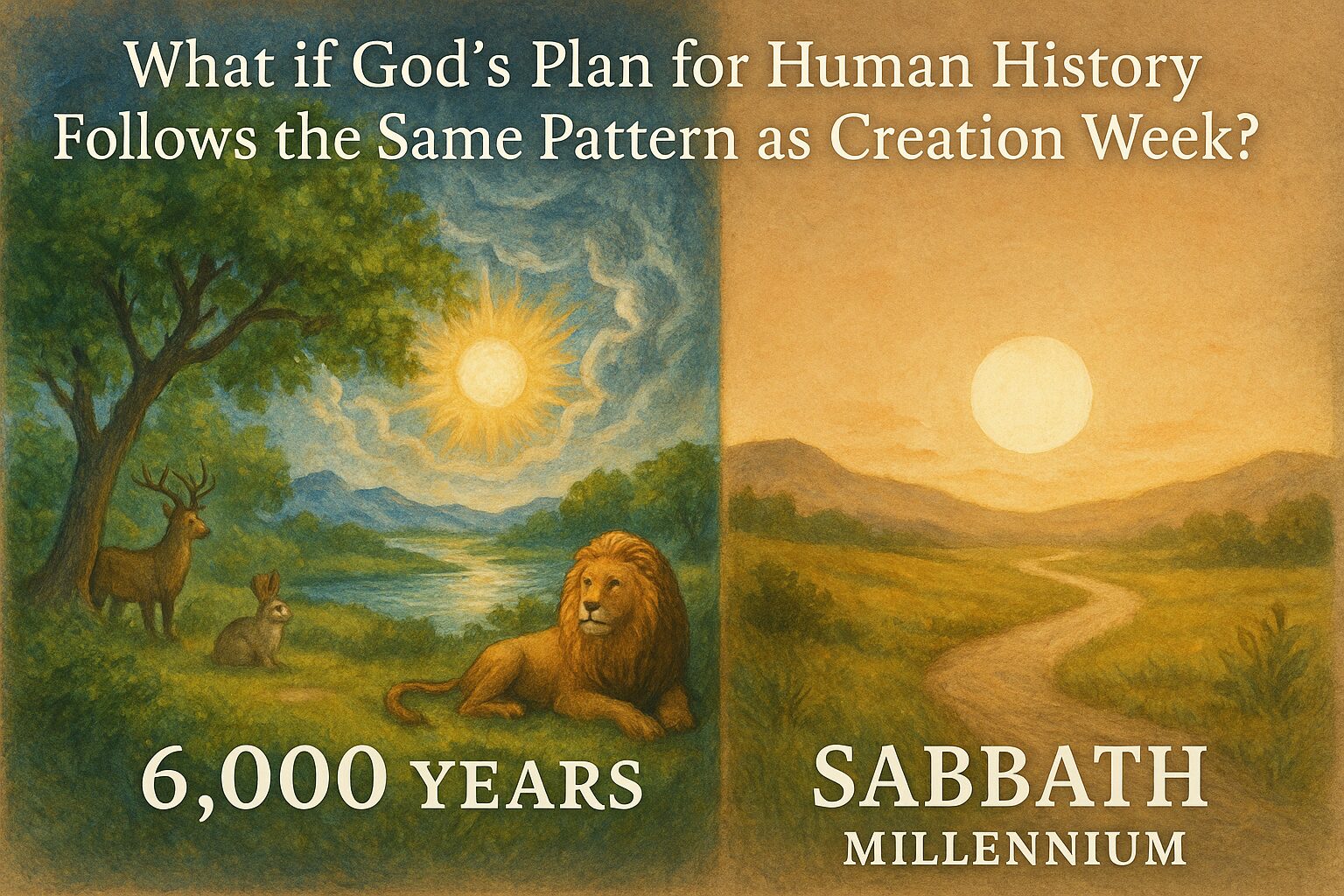
Is the Earth destined to just 7,000 years?

What if God’s plan for human history follows the same pattern as Creation week? For millennia, Jewish and Christian scholars have recognized a compelling framework: just as God worked for six days and rested on the seventh, perhaps human history spans 6,000 years followed by a final “Sabbath” millennium. This isn’t date-setting or speculation—it’s a biblical pattern supported by Scripture and early church tradition that helps us understand where we might be in God’s timeline.
The Biblical Foundation
The framework comes directly from Scripture. 2 Peter 3:8 and Psalm 90:4 both state that “with the Lord one day is as a thousand years, and a thousand years as one day.” Early believers used this lens to consider God’s plan across history.
“But do not overlook this one fact, beloved, that with the Lord one day is as a thousand years, and a thousand years as one day” (2 Peter 3:8). Could this be more than metaphor?
The Creation Week Template
Creation week sets the rhythm: six days of work, one day of rest. If each day symbolically represents 1,000 years, human history maps to 6,000 years of toil followed by a millennial Sabbath when Christ reigns.
📅 The Pattern
- Days 1–6: God works → 6,000 years of human history
- Day 7: God rests → 1,000-year Sabbath reign
- Beyond Day 7: New creation → new heavens and new earth
- Biblical thread: Hebrews 4 connects Sabbath rest to God’s ultimate rest
Ancient Witnesses Support This View
This wasn’t a medieval invention. Jubilees notes Adam died within the first “day” (under 1,000 years). Early church voices like Irenaeus, the Epistle of Barnabas, and Lactantius referenced the six-thousand-years-then-rest framework. They set expectations, not dates.
Ancient Support
- Jubilees 4:30: Adam’s death within the first “day”
- Barnabas: 6,000 years then rest
- Irenaeus: Pattern noted in Against Heresies
- Lactantius: Millennial Sabbath described
The Jubilees Quote
“For one thousand years are as one day in the testimony of heaven… therefore he did not complete the years of that day, for he died within them.”
This ties the 1,000-year “day” concept to biblical chronology.
Calendar Complications: Why the Math Gets Tricky
Jubilees and 1 Enoch advocate a 364-day “perfect year,” warning that changing year length distorts appointed times. Using differing calendars—or genealogical traditions—yields different totals, which is why date-setting backfires.
⚠️ Why Different Calculations Exist
- Calendars: 364-day vs. 365.25-day years
- Chronologies: Masoretic vs. Septuagint genealogies
- Starting points: Creation vs. Adam’s expulsion vs. flood
- Result: Multiple plausible windows (e.g., 2030s–2100s)
Where Are We Now?
Many conservative tallies place us roughly in the 6,000-year vicinity from Creation. If the framework is right, we’re near a transition—yet Jesus forbids knowing the day or hour. Think seasons and posture, not dates.
We can note the signs Jesus gave—wars and rumors of wars, disasters, deception—aligning with what we’d expect approaching the end of the “six days.”
What This Means for Us
Rather than anxiety, this should cultivate hope. If the six “days” are closing, the Sabbath millennium draws near. Revelation 20 depicts Christ’s reign—the fulfillment of Sabbath rest prefigured since Creation.
Practical Implications
- Live with expectation: Christ’s return could be soon
- Keep perspective: Current struggles are temporary
- Work with urgency: The harvest matters
- Rest in God’s plan: History has purpose and direction
What to Avoid
- Date-setting: Explicitly prohibited
- Fear-mongering: This should produce hope
- Wild speculation: Stay anchored to Scripture
- Complacency: Be faithful until He comes
💡 Key Takeaway
The 7,000-year framework offers perspective without dates. It invites expectant living—neither presumptuous nor complacent.
The Sabbath Rest Connection
Exodus 20:8–11 roots Sabbath in Creation. If the pattern scales to history, the seventh millennium becomes the ultimate Sabbath—1,000 years when “the earth shall be full of the knowledge of the LORD.”
This ties our weekly rhythm of work and rest to the grand arc of redemption: every Sabbath a rehearsal for the ultimate rest; every workweek a reminder that present struggles are temporary.
Living in the Light of Eternity
Whether we’re in the final years of the 6,000 or decades away, the call is the same: urgency and rest. Urgency because the gospel matters now; rest because God’s plan is on schedule. The early fathers weren’t predicting—they were discerning the character of a God who works in patterns, keeps promises, and brings His people into perfect rest.
Want to explore more prophetic patterns? See more resources on PracticallyAdventist.com—anchored in Scripture, without sensationalism.
Tags: Featured
Leave a Reply